
Chosen or Kept Around? The Difference That Protects Your Well-Being
Men, Boundaries, Self-Worth, Relationships
Chosen or Kept Around? The Difference That Protects Your Well-Being
For the sake of your peace and your power as a man, you must learn the difference between being chosen and being kept around. One nourishes you. The other drains you slowly while you smile through your own neglect.

The Man Who Shows Up, But Is Never Chosen
He’s standing in the driveway again. Third time this month. It’s late, and he has work in the morning, but her text said, “Can you come? I just need you right now.” So he grabbed his keys and went. Again. No questions. No pushback. Just show up, fix, absorb, repeat.
He’s the one who answers when her boyfriend disappears. He’s the one who helps his sister move at the last minute because everyone else “couldn’t make it.” He’s the guy at work who takes the extra shift, finishes the project, covers the mess someone else left behind. The friend who drives across town at midnight. The son who drops everything when his parents call—though they rarely ask how he’s really doing in return.
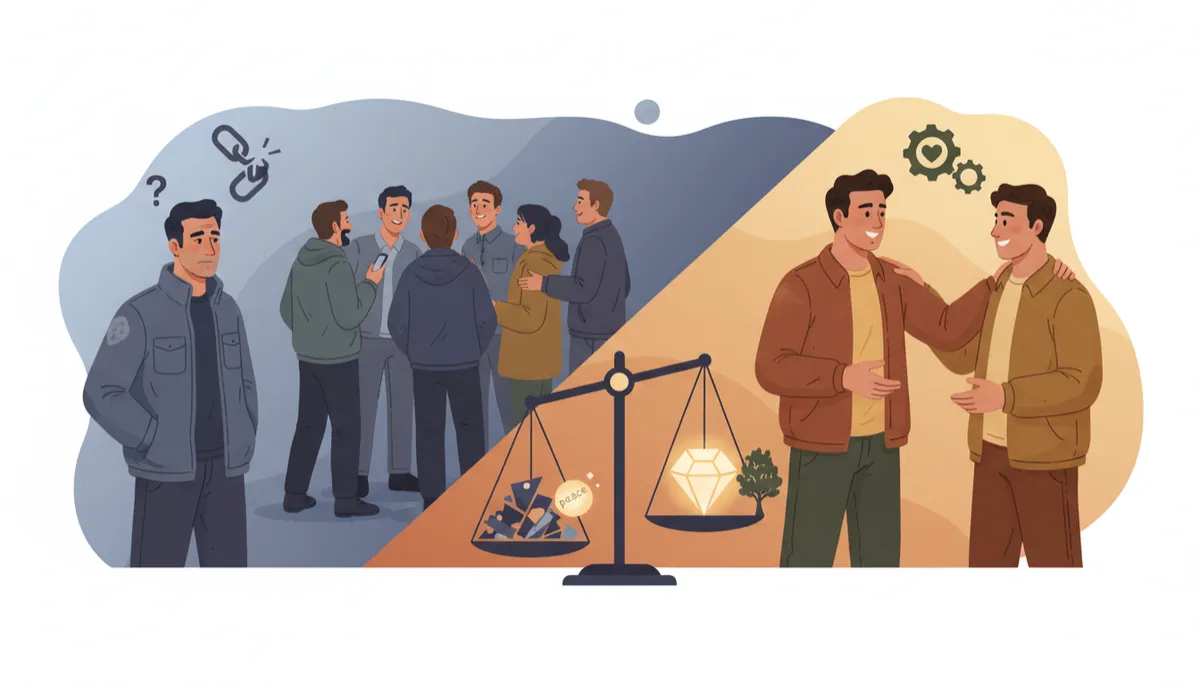
He’s dependable. Solid. The rock. People say, “You’re such a good guy. I don’t know what I’d do without you.” But when it’s time for invitations, celebrations, real decisions, real intimacy, he finds out on social media. Or from someone else. Or not at all. He’s there for the heavy lifting, but never the first choice for the good seats at the table. That’s chosen vs kept around in one man’s life, playing out on repeat while he calls it loyalty and wonders why he feels so empty on the drive home.
Being Needed vs Being Valued: The Quiet Trap for Good Men
As men, we’re taught early that being needed is a badge of honor. You provide. You fix. You show up. People lean on you, and it feels like proof that you matter. But there’s a hard truth here: being needed is not the same as being valued. And confusing the two is how a sovereign man slowly gives his life away piece by piece while calling it love, loyalty, or “being a good guy.”
Being needed is about utility. What you can do. Your money, your time, your skills, your emotional labor. It’s transactional. “I need you” often means “I need what you provide.” When the need is met, you get shelved until the next emergency. You’re the tool in the box—picked up when useful, put away when the job is done.
Being valued is different. It’s about your presence, your essence, your character. People who value you don’t just want your help; they want you in the room. They invite you in before they need something. They ask how you are and actually wait for the answer. They include you in plans, not just problems. That’s self-worth in relationships reflected back at you, not just demand on your energy.
Five Signs You Are Being Kept Around, Not Chosen
Let’s get brutally honest. If you want to protect your peace and stand as a sovereign man, you need to see the signs you are being kept around—in romantic relationships, friendships, family, and work. Convenience is not commitment. Access is not intimacy. Attention is not devotion. Here are five signs you are being kept around instead of truly chosen.
- They call when they need something. The pattern is simple: they reach out when they’re in crisis, bored, or stuck. When things are smooth, you don’t hear from them. Your phone lights up only when there’s a fire to put out. You’re the emergency contact, not the everyday companion. That’s being needed vs valued in its rawest form.
- You’re last to know, first to help. Engagements, promotions, breakups, big moves—everyone else seems to know before you. But when it’s time to move the furniture, spot the loan, listen to the late-night venting, suddenly you’re at the top of the list. In family, at work, in your friend group, you’re the first to serve and the last to be seen.
- They’re hot one week, cold the next. One week they’re all over you—calling, texting, praising, making you feel like you finally matter. The next week, silence. Short replies. Vague excuses. You’re on an emotional rollercoaster you never bought a ticket for. This “hot one week, cold the next” cycle keeps you hooked, hoping the warm version of them returns, while your nervous system pays the price.
- You’re invited last minute—if at all. You find out about gatherings, trips, or important meetings right before they happen. “Hey man, we’re all here, you should swing by if you can.” Translation: we filled the table, and now we’re seeing if you’re free to fill a gap. In the office, it’s, “We already started the project, but we’d love your input now.” You’re the add-on, not the plan.
- You feel like an option, not a priority. This is the deepest sign. You don’t need a spreadsheet to track it; your body already knows. You feel anxious, uncertain, and slightly ashamed for wanting more. You catch yourself wondering, “If I stopped reaching out, would they even notice?” That’s the truth trying to surface: you’re being kept around, not chosen.

Many men only wake up to the pattern after years of sitting at tables they built but were never honored at.
Three Questions to Ask Before You Give Someone More of You
A sovereign man doesn’t just give his time, energy, and heart on autopilot. He vets. He observes. He chooses who gets access. Before you offer more of yourself—to a woman, a friend, a family member, a boss—ask these three questions and answer them with ruthless honesty. This is men boundaries in practice, not theory.
- Who shows up when it’s not convenient? Not when it’s fun, not when it makes them look good, not when there’s a crowd watching. Who actually shows up for you when there’s no benefit, no spotlight, no payoff? Those are the people who see you, not just use you. If no one comes to mind, that’s not a reason to shame yourself—it’s a reason to shift how you give and who you allow close.
- Who makes time without being asked? Pay attention to who initiates. Who reaches out first? Who checks in because they want to, not because you nudged them? In romantic relationships, friendships, family, and work—who proactively makes space for you? If you’re always the one chasing, reminding, and following up, you’re carrying the entire connection on your back.
- Do you feel calmer or more anxious around them? Your nervous system doesn’t lie. With people who genuinely choose you, you feel grounded, seen, and more yourself. With people who only keep you around, you feel like you’re walking on eggshells—trying not to say the wrong thing, trying to stay useful, trying to be enough. If your body tightens every time their name pops up on your phone, believe that data. That’s how you protect your peace.
Auditioning for a Seat You Should Be Offered Costs Your Peace
Too many men live like they’re at a permanent audition. You over-give, over-explain, over-perform. You’re constantly trying to prove you’re worthy of a spot in someone’s life, team, or family. You treat every interaction like a test: “If I do enough, maybe they’ll finally see me. Maybe I’ll finally be chosen.” That mindset is poison to your self-worth in relationships.
Here’s the truth: any seat that requires you to constantly audition is not your seat. A healthy partner doesn’t make you compete with their chaos for basic respect. A real friend doesn’t make you earn your way into their life every week. A solid leader at work doesn’t keep you dangling just close enough to hope but far enough to stay insecure. When you live in audition mode, your nervous system never rests. Your peace is the price of admission, and the show never ends.
Auditioning drains you in three ways:
- Mental: You overthink every word, every message, every silence. Your mind runs scenarios instead of resting in reality.
- Emotional: Your sense of worth rises and falls with their attention. You’re up when they’re warm, wrecked when they’re cold.
- Spiritual: You abandon your own center. You forget that you are the man who chooses, not just the man hoping to be chosen.
“The seat meant for you is offered, not dangled. If you have to beg for it, it’s not yours.”
How to Stop Chasing, Set a Boundary, and Invest in People Who Choose You Back
This is where men get stuck. You see the pattern. You feel the cost. But you don’t know how to step out of it without feeling guilty, selfish, or alone. Here’s the reality: boundaries are not walls, they are doors. They don’t lock you away; they filter who gets in. This is the work of a sovereign man—not waiting to be treated right, but leading with standards that protect his well-being.
1. Stop Chasing: Let the Silence Speak
The first move is simple, but not easy: stop chasing. Stop double-texting. Stop being the only one to initiate. Stop rearranging your life for people who treat you as an afterthought. In romantic relationships, stop trying to convince someone to see your value. In friendships, stop forcing connections that only move when you push. In family, stop being the only one holding the relationship together while everyone else coasts on your effort. In work, stop volunteering for every extra task to feel worthy of your position.
When you stop chasing, something uncomfortable happens: the truth shows up. You quickly see who reaches back and who disappears. Let that information land. Don’t explain it away. Don’t rush to fill the gap. A man grounded in personal growth doesn’t panic when people fall away; he recognizes it as alignment, not loss.
2. Set a Boundary: Say It Once, Then Live It
Boundaries are not long speeches. They are clear standards backed by consistent action. In every area—romantic, friendship, family, work—you can articulate your boundary in a simple, direct way:
- Romantic: “I’m not available for hot-and-cold dynamics. If we’re building something, it needs to be consistent on both sides.”
- Friendships: “I’m no longer the guy you only call in a crisis. If this friendship matters, it needs to be mutual.”
- Family: “I love you, but I won’t keep overextending when there’s no effort coming back. This has to go both ways.”
- Work: “I’m committed to doing my job well, but I’m no longer taking on extra unpaid responsibilities by default.”
Then—and this is where most men fall off—you live the boundary. You don’t argue, explain, beg, or chase. You simply adjust your access. Less availability. Less emotional labor. Less rearranging your life for people who won’t meet you halfway. That’s how men boundaries move from theory to reality.
3. Invest in People Who Choose You Back
Once you start to pull your energy back from those who only keep you around, you create space. Use that space wisely. Invest in people who answer the three questions well: they show up when it’s not convenient, they make time without being asked, and your body feels calmer around them. That’s where you put your time, money, attention, and heart. That’s where personal growth men happens in real time, in real relationships.
In practice, this means:
- Saying yes to invitations from people who consistently show up for you, even if it’s not the “cool” crowd.
- Building friendships with men who call you forward, not just call you when they’re bored or drunk.
- Choosing romantic partners who match your effort and consistency instead of chasing chemistry with chaos.
- Aligning your career with leaders and teams who actually recognize your value, not just your capacity to grind.
Protect Your Peace Like It’s Your Job—Because It Is
Your peace is not a luxury. It’s not something you get around to once everyone else is taken care of. Your peace is the foundation of your decisions, your health, your leadership, your relationships, your entire life. When you let people keep you around instead of choosing you, you are trading that peace for scraps of attention. That’s too high a price for any man to pay, especially one committed to living as a sovereign man.
You’re not here to be everyone’s backup plan, emotional mechanic, or unpaid therapist. You’re here to build a life with people who recognize your value, not just your availability. That means you must protect your peace with the same intensity you protect your work, your money, or your family. Because without peace, everything else you build rests on shaky ground.
Boundaries & Brotherhood: You Don’t Have to Do This Alone
Men are often told to “man up” and handle this stuff solo. But isolation is exactly how you end up tolerated instead of treasured, needed instead of valued, kept around instead of chosen. You deserve a circle of men who get it—men who are also done auditioning, done chasing, and ready to live with clear standards and solid boundaries in every area of life.
That’s why we built the Boundaries & Brotherhood community. It’s a space for men 30–55 who are serious about personal growth, men boundaries, and self-worth in relationships—not as theory, but as daily practice. We talk about chosen vs kept around. We break down real situations—romantic, friendship, family, work—and we sharpen each other so no man has to keep living as a convenient option in his own life.
If you’re reading this and realizing how much of your life has been spent being kept around, start with clarity. Inside Boundaries & Brotherhood, we offer a free assessment to help you see exactly where your boundaries are leaking, where you’re over-giving, and where you’re being tolerated instead of chosen. It’s direct, it’s honest, and it’s built for men like you who are ready to stop bleeding energy into one-sided connections.
Final Word: You Are Allowed to Be Chosen
You’ve spent enough years proving you’re reliable. You’ve shown you can carry weight, fix problems, and stand in the fire. That part is not in question. The question now is different: Will you keep living as a man who is merely needed, or will you stand as a man who is truly valued? Will you keep auditioning for seats that were never meant for you, or will you claim the ones that are offered freely, with respect and reciprocity?
Being chosen is not about ego. It’s about alignment. It’s about standing in relationships—romantic, friendship, family, work—where your effort is matched, your presence is respected, and your peace is protected. That’s the standard. That’s the call. And that’s the kind of man Boundaries & Brotherhood is here to support you in becoming and remaining: direct, raw, sovereign, masculine, and deeply compassionate—starting with yourself.