

Embrace Self-Respect: Outgrow Toxic Relationships
Boundaries, Brotherhood, Men's Mental Health, Self-Respect, Sovereign Man
You Were Never Losing People — You Were Losing the Version of Yourself That Kept Tolerating Them
There comes a moment in every man’s life when he realizes the real loss was never them — it was the parts of himself he kept abandoning just to keep them close.

The False Story You Tell Yourself When People Leave
Let’s be honest, brother. When someone pulls away, ghosts you, or slowly fades out, your first instinct is rarely sovereignty. It’s self-blame. Your mind goes straight to, “What did I do wrong?” You replay conversations. You analyze texts. You scan your memory for that one moment you “messed it up.”
You start checking who watched your stories, who liked your posts, who noticed your silence. You treat your own absence like a performance and the audience’s reaction becomes your worth. That’s not leadership. That’s emotional begging dressed up as “caring too much.”
Men do this quietly. We don’t always say it out loud, but we feel it. When a woman pulls back, when a friend stops reaching out, when a family member gets distant, we build a story: “If they left, it must be because I wasn’t enough.” That story eats at your self-respect and your mental health. It keeps you locked in shame and overthinking instead of grounded in truth and boundaries.
That story is a lie. But as long as you believe it, you’ll keep chasing people who have already shown you they can’t—or won’t—meet you where you’re going. You’ll keep shrinking your standards just to keep them from leaving. And every time you do that, a little more of you walks out on yourself.
The Reframe: You Weren’t Losing Them — You Were Losing the Version of You That Tolerated Them
One day, something shifts. You stop checking who noticed your absence. You stop stalking their reactions. You stop trying to decode why they changed. The question “What did I do wrong?” gets tired. It loses its grip. And then you see it clearly: you were never really losing people. You were losing the version of yourself that kept tolerating them.
That version of you was constantly over-explaining, over-giving, over-apologizing. He laughed off disrespect. He swallowed his needs. He accepted inconsistency as “just how they are.” He confused access with connection and familiarity with loyalty. He carried the whole relationship on his back and called it “being a good man.”
When you start honoring your boundaries, that version of you can’t survive. He was built on self-abandonment. So when people fall away as you grow, it’s not proof that you’re unlovable. It’s proof that the old, tolerating version of you is dying off. And he needs to. He was killing you slowly anyway—killing your confidence, your clarity, your ability to trust yourself.
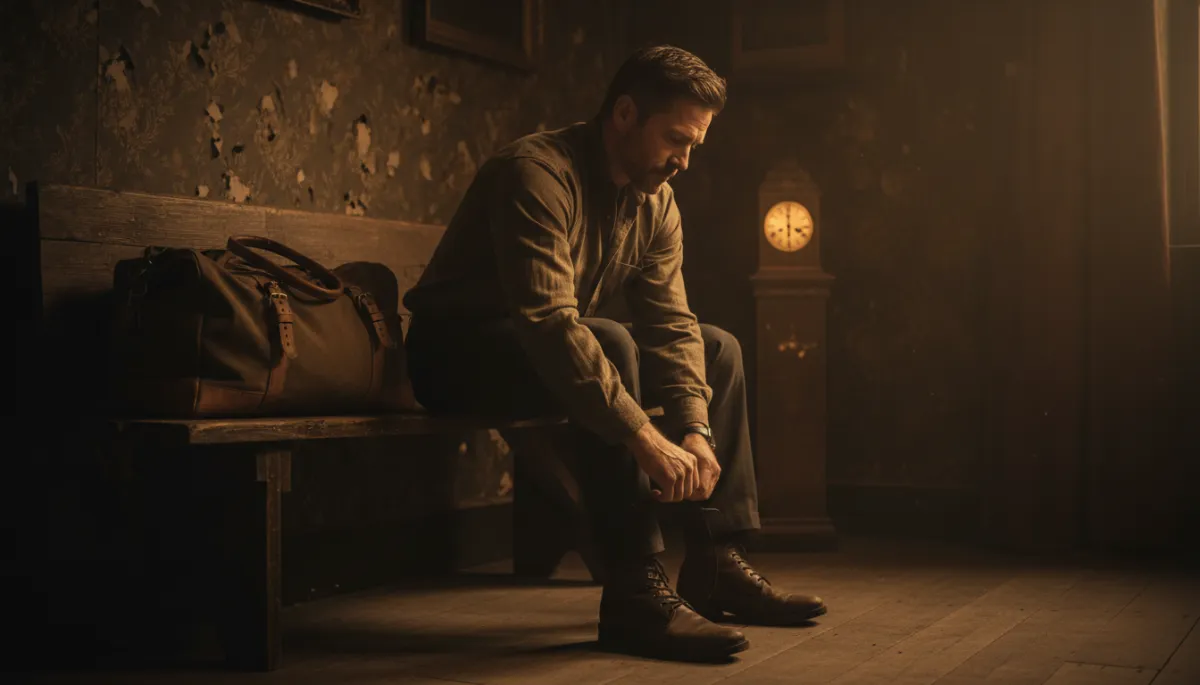
When you outgrow a season, you stop packing excuses and start packing truth.
Outgrowing people is often just outgrowing your own lack of standards. It’s not about hating them. It’s about finally refusing to betray yourself to keep the peace. That’s the beginning of becoming a sovereign man: you choose self-respect over self-sacrifice for the wrong people.
What Outgrowing People Actually Looks Like (No Drama, No Revenge)
Outgrowing people isn’t always a big speech, a dramatic exit, or a social media purge. Most of the time, it’s quiet. It’s subtle. It’s you choosing differently—again and again—until the dynamic simply can’t stay the same. No announcement. No revenge. No explanation tour. Just a man who’s no longer available for what drains him.
- You stop chasing. If they pull away, you let the distance be information, not a trigger to prove your worth.
- You stop over-explaining. You say “No, that doesn’t work for me” without a five-paragraph essay attached.
- You stop tolerating disrespect, inconsistency, and one-way effort—no arguments, just less access.
- You stop trying to fix people who have no intention of changing. You reclaim that energy for your own growth.
Outgrowing people looks like a quieter mind. You’re not running constant simulations of what you should have said or done. You’re not scripting imaginary confrontations. You’re present in your own life again. You have more mental space because you’re not constantly managing other people’s comfort at the expense of your own sanity. That’s what real boundaries feel like from the inside: calm, not chaos.
When Self-Respect Becomes the Driver
Self-respect is not a feeling that shows up after everyone treats you right. It’s a standard you choose before they do. It’s the inner line that says, “This is what I will and will not allow in my life, no matter how lonely it feels in the short term.” That’s the core of sovereignty: you govern you. You don’t outsource your boundaries to other people’s behavior.
When self-respect becomes the driver, you stop asking, “How do I keep them?” and start asking, “Does this align with the man I’m becoming?” That question changes everything. It shifts your focus from scarcity to alignment. From fear to clarity. From chasing belonging to building brotherhood with men who are also committed to growth, honesty, and responsibility.

Brotherhood begins when self-respecting men stop bonding over weakness and start rising together.
This is men’s mental health at the root level. Not just coping, but choosing a life where you don’t have to bleed out emotionally to keep your connections. You build relationships that can handle your truth. You attract people who respect your “No” because you respect it first. Your world might get smaller, but it gets stronger, cleaner, and more honest. That’s the terrain where a sovereign man thrives.
Ready to Audit Your Boundaries and Step Into Sovereignty?
If what you just read hits a nerve, that’s not an accident. It’s a signal. Somewhere inside, you know you’ve been tolerating too much: weak friendships, half-committed partners, draining family dynamics, or even your own patterns of self-betrayal. You’re not broken. You’re just overdue for a sovereignty check.
At Boundaries and Brotherhood, we built a simple but confronting tool to help men like you see exactly where you’re giving your power away: the Sovereignty Assessment. It’s not fluff. It’s not a personality quiz. It’s a mirror. It shows you where your boundaries are strong, where they’re leaking, and where you’re still that old version of yourself who tolerates what’s slowly destroying him.
You don’t need to hate anyone to move on. You don’t need revenge. You don’t even need closure from them. What you need is commitment to yourself. The day you choose that, you’ll realize you were never really losing people. You were losing the parts of you that kept giving away your power. Let that version of you go. He served his purpose. Now it’s time to build a life where access to you is earned, not assumed—and where your boundaries, self-respect, and brotherhood all align with the sovereign man you’re here to become.
Title Tag: You Were Never Losing People — You Were Losing the Version of Yourself That Kept Tolerating Them | Boundaries and Brotherhood
Meta Description: Discover why you were never really losing people, only the version of yourself that tolerated them. Learn how boundaries, self-respect, and brotherhood shape the sovereign man, and take the Sovereignty Assessment from Boundaries and Brotherhood.
SEO Keywords: boundaries, outgrowing people, self-respect, men's mental health, sovereign man, Boundaries and Brotherhood, brotherhood, emotional boundaries for men, personal sovereignty, men’s personal development