

The Hidden Skill Every Man Is Starving For
Self-Control, Sovereignty, Men's Personal Development, Discipline, Emotional Control
The Man Who Controls Himself Controls His World: The Hidden Skill Every Man Is Starving For
Most men think they have a discipline problem. They don’t. They have a control problem. And until you see the difference, you’ll keep rebuilding the same weak life on a cracked foundation.

"The man who controls himself controls his world."
Discipline Is A System. Control Is A Choice.

Discipline is the calendar, the routine, the habit stack. It is the external system you build to guide your days. You can copy it from a book, a podcast, or a YouTube guru. It looks good on paper. It feels productive to plan.
Control is different. Control is the moment you want to break your own rules and you don’t. It is the second before you speak, click, drink, scroll, or explode. It is the internal decision to stay sovereign over yourself when everything in you wants to leak power.
"Discipline is a system. Control is a choice."
This is why discipline alone fails most men. You can have the perfect morning routine and still be a slave to your impulses by noon. You can hit the gym at 5 a.m. and still lose your temper at 5 p.m. Discipline without self-control is just a polished cage. You look organized. Inside, you’re still owned by whatever hits your nervous system hardest.
Sovereignty is not how pretty your system looks. Sovereignty is whether you can hold the line when your system gets punched in the mouth.
Where Men Bleed Out Control

Every uncontrolled reaction is a quiet transfer of power away from you.
Men don’t usually lose control in grand, cinematic moments. They lose it in small, repeatable leaks that slowly drain their sovereignty and self-respect. You know the list. You live it.
Anger. You snap. You raise your voice. You slam a door. For ten seconds, you feel powerful. Then the shame hits. You didn’t lead. You lost control. Everyone in the room felt it.
Habits. Late-night scrolling. Porn. Junk food. One drink that turns into four. You tell yourself you’ll stop tomorrow. Tomorrow never volunteered for that job.
The past. Old wounds run your present. Your father’s voice. That betrayal. That failure. You’re not reacting to now. You’re reacting to a ghost that still owns equity in your nervous system.
Reactivity. A text. A look. A comment. You fire back. No pause. No scan. No choice. Just stimulus and automatic response like a script you never wrote but keep performing.
Every time you react instead of respond, you hand your world to someone else. Your boss. Your partner. Your trigger. Your past. They push the button. You dance.
The Three Pillars Of Self-Sovereignty
Self-control is not one thing. It is a stack. A system inside you. As a senior engineer, I think of it like a three-layer architecture for your life. If one layer fails, the whole system is compromised. The three pillars of men’s personal development at the sovereignty level are emotional control, behavioral control, and mental control.
1. Emotional Control — You Feel It, You Don’t Obey It
Emotional control is not numbness. It is the capacity to feel fully and still choose your behavior. Anger, fear, shame, desire — you register them like logs in a system monitor. You don’t let them deploy code to production without your approval.
trigger = "disrespect"
emotion = "anger"

if emotion == "anger":
    pause()
    breathe()
    choose_response()
That is emotional sovereignty. The event doesn’t own you. You own the gap between event and action.
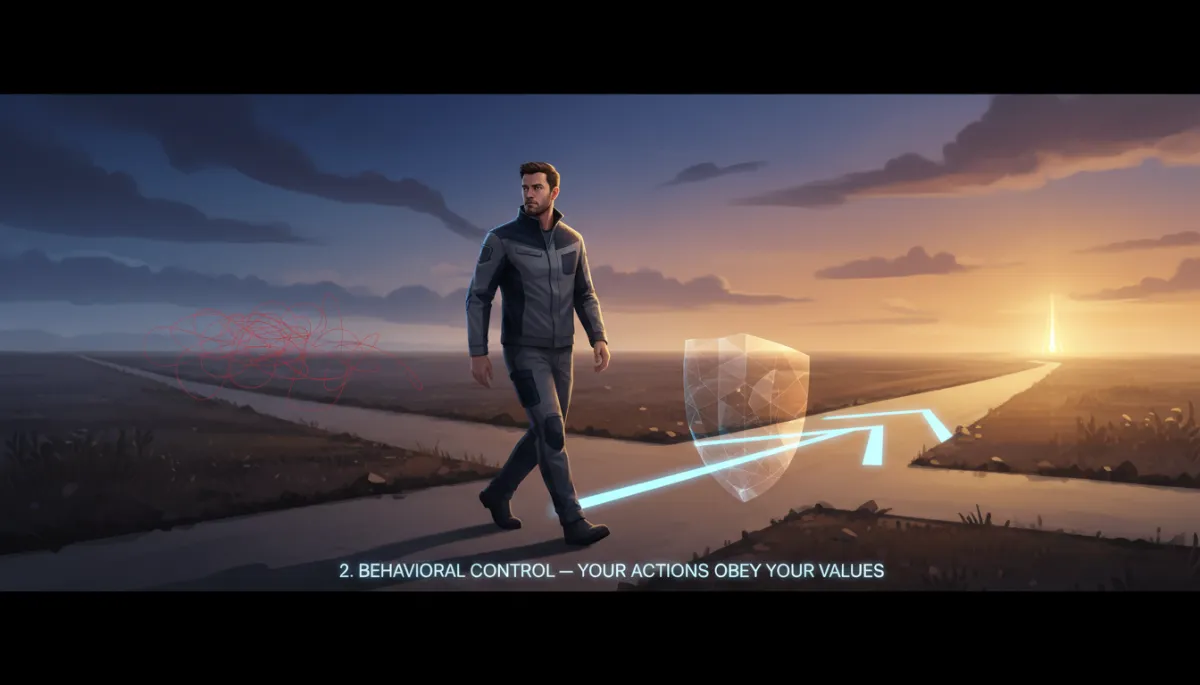
2. Behavioral Control — Your Actions Obey Your Values
Behavioral control is the alignment between what you say you value and what you actually do when no one is watching. It is the ability to keep your word to yourself. Not occasionally. Consistently. You treat your behaviors like production code — tested, intentional, not hacked together in the dark.
values = ["strength", "honor", "clarity"]

def behavior_allowed(action):
    return action in ["train", "build", "repair", "lead"]

action = "doomscroll"

if not behavior_allowed(action):
    block(action)
    replace_with = "read"
    execute(replace_with)
You become the kind of man whose calendar and browser history match his claimed standards.
3. Mental Control — You Choose The Story Running Your Life
Mental control is about the narratives and beliefs you allow to loop in your head. “I always screw this up.” “I’m not that guy.” “This is just who I am.” Those are scripts, not truth. You can refactor them. You can ship a new story.
thought = "I always lose control."

if "always" in thought:
    thought = "I used to lose control. Now I'm learning control."

install(thought)
When you control the story, you control the frame. When you control the frame, you control how you show up.

Sovereignty is built when emotion, behavior, and thought answer to you.
You Don’t Start With Willpower. You Start With A Mirror.
Most men try to fix self-control with more willpower. More grind. More shame. That’s like trying to fix bad code by typing harder. Willpower has its place, but it is a weak primary tool. You can’t brute-force your way to sovereignty. You start with awareness.
You need a clear audit of where you’re bleeding control — emotionally, behaviorally, mentally. Not vague. Not “I should do better.” Precise. Measurable. Brutally honest. That’s what the Sovereignty Assessment is. It’s a mirror, not a motivational poster. It shows you exactly where you’re losing control before you try to fix it.
As engineers say, “You can’t optimize what you don’t measure.” Same with your life. You can’t reclaim what you refuse to see.
Your Move
If you’re tired of pretending discipline alone will save you. If you’re done handing your power to anger, habits, the past, and cheap reactions. If you’re ready to step into real self-control and sovereignty as a man — start with the mirror.
Go to assessment.boundariesandbrotherhood.com. Take the Sovereignty Assessment. See exactly where you’re not in control. Then you can choose to change it.
Free. 3 minutes. No fluff. Just your truth.
The Real Win: What’s In It For You
At the end of all of this, it isn’t about a cute framework, a clever quote, or another thing to “work on.” It’s about the kind of man you get to be — for yourself, for the people you lead, and for the life you say you want.
When you take your sovereignty seriously and actually measure where you’re losing control, you stop living on default. You stop being dragged by your emotions, your habits, and your past. You start living by design.
📌 Key Takeaway: The assessment isn’t about judging you. It’s about handing you the controls you keep saying you want.
Before You Click Away, Sit With This
Don’t just skim this and move on to the next hit of content. Ask yourself, honestly:
Where did I lose control this week — emotionally, behaviorally, or mentally — and what did it cost me?
Who in my life has had to absorb the impact of my reactions, my addictions, or my avoidance?
If my son, my younger brother, or my past self watched me for 24 hours, would he see a man in control or a man controlled?
What am I pretending is “no big deal” — the habit, the outburst, the story in my head — that is actually eroding my self-respect?
If nothing changed for the next 12 months, and I kept the same level of control I have right now, would I be proud of where that leads?
💡 Pro Tip: Don’t just think these questions. Write your answers down. Men who put their truth on paper are the ones who actually change.
What’s in it for you if you actually follow through and take the Sovereignty Assessment?
Clarity: You stop guessing and finally see, in black and white, where you’re strong and where you’re bleeding out control.
Leverage: You know exactly which small shifts will create the biggest changes in how you feel and how you lead.
Respect: You start rebuilding trust with the only man you can’t escape — the one in the mirror.
Peace: Less chaos inside your head, fewer regrets at night, more calm in the moments that used to own you.
Power: The quiet, grounded kind — where your emotions, behaviors, and thoughts report to you, not the other way around.
The world doesn’t need more men who look disciplined. It needs more men who are actually in control of themselves.
That’s what’s on the table for you: a life where you don’t just talk about standards, sovereignty, and control — you embody them. The assessment is just the first step. The decision to take it is the first act of control.