
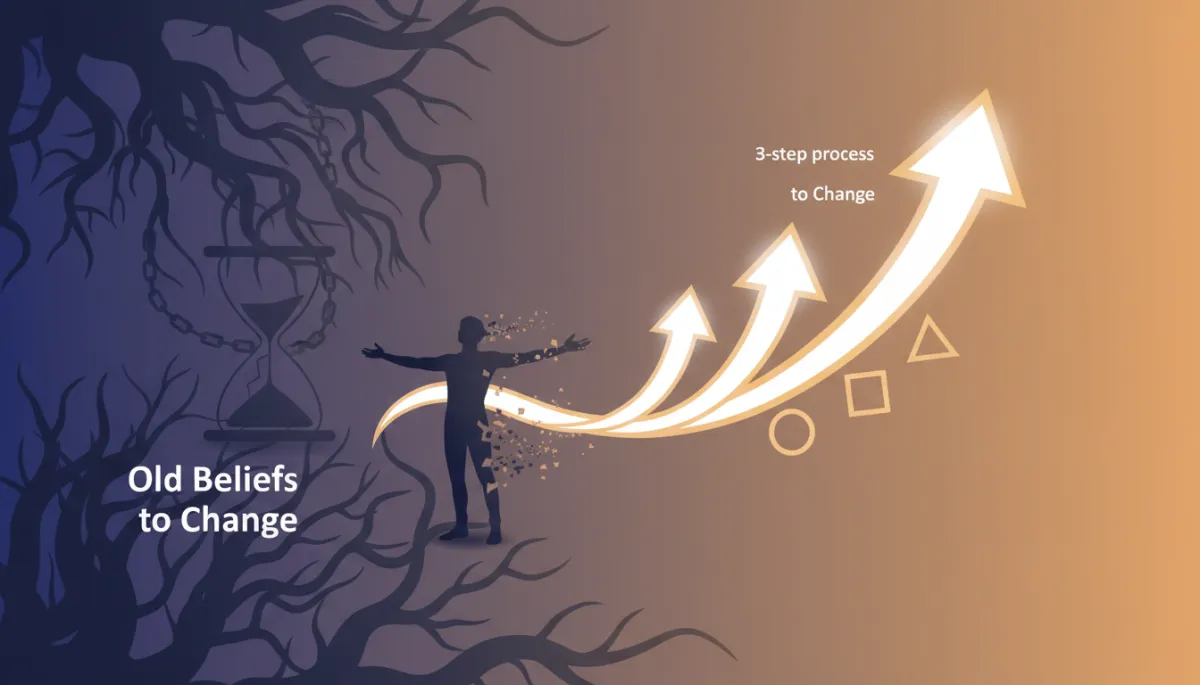
Transform Old Beliefs: 3 Steps to Change Behavior
Personal Growth, Mindset, Behavior Change
How Old Beliefs Quietly Shape Your Current Behavior (and 3 Steps to Change Them)
You can set goals, download habit apps, and repeat affirmations—yet still feel pulled back into the same patterns. You stay up late scrolling even though you’re exhausted, say “yes” when you mean “no,” or sabotage progress just when things start going well.
Under the surface, you may be wrestling with:
Self-sabotage: undermining your own progress right when you’re close to a win
People-pleasing: putting everyone else first and feeling invisible or resentful
Burnout cycles: pushing hard, crashing, then starting over again and again
Fear of success or failure: staying “stuck” because both moving forward and staying put feel scary
Often, the real reason is simple: your old beliefs are still running the show behind the scenes. This article will show you how those beliefs quietly drive your behavior—and a clear, 3-step process to start changing them so your new habits can finally stick.
How Old Beliefs Quietly Direct Your Daily Choices
Beliefs are the stories you tell yourself about who you are, what is possible, and how the world works. Many of them formed years ago—from parents, culture, school, or painful experiences. Even if you rarely think about them, they still act like an operating system in the background, filtering every decision you make.
Consider a few common examples of old beliefs:
“I’m just not good with money.”
“If I rest, I’m lazy.”
“People always leave, so it’s safer not to get too close.”
Now notice how each belief naturally leads to specific behavior: “I’m not good with money” can justify avoiding budgets or ignoring bank statements. “If I rest, I’m lazy” can drive burnout. “People always leave” can make you pull away just when a relationship starts to deepen. The belief comes first; the behavior follows.
📌 Key Takeaway: If your actions don’t match your current goals, you’re probably living by yesterday’s beliefs.
The 3-Step Process to Change Old Beliefs (So New Habits Can Stick)
Step 1: Spot the Old Story Behind the Behavior
You can’t change what you can’t see. The first step is to notice the story underneath your actions. Instead of only asking, “Why did I do that?”, ask, “What would I have to believe for this behavior to make sense?”
You procrastinate on a big opportunity → possible belief: “If I try and fail, I’ll prove I’m not good enough.”
You over-give in relationships and feel resentful → possible belief: “My needs don’t matter as much as other people’s.”
A simple reflection exercise can help. At the end of the day, choose one behavior you didn’t like—snapping at a partner, scrolling instead of sleeping, skipping a workout—and write:
What I did:
How I felt:
The belief that might be driving this:
💡 Pro Tip: Look for beliefs that sound absolute—using words like “always,” “never,” or “everyone.” These are often the oldest and most powerful.
Step 2: Question the Evidence and Soften the Belief
Once you’ve named a belief, don’t rush to replace it with a positive slogan. Your mind won’t buy “I am wildly successful” if it has years of “I’m a failure” filed away. Instead, gently question the belief like a curious investigator, not a harsh judge.
“When did I first learn this?”
“Who gave me this idea—and were they actually right?”
“Where is this belief not true? What are the exceptions?”
Suppose your belief is “I always mess things up.” You might remember times you handled a crisis well, finished a project, or supported a friend. The goal is not to flip the belief overnight, but to soften it into something more balanced, like: “Sometimes I struggle, but I’ve also handled many things well.”

Questioning old beliefs with evidence slowly loosens their grip on behavior.
Step 3: Practice a New Belief Through Small, Repeated Action
Beliefs change when your brain sees new proof. That means pairing a more helpful belief with small, consistent actions that support it. Think of it as training a muscle rather than flipping a switch.
Old belief: “I’m terrible with money.” New belief-in-progress: “I can learn to handle money better.” New action: Checking your account for two minutes each day and tracking one number.
Old belief: “Rest is lazy.” New belief-in-progress: “Rest helps me show up better.” New action: Scheduling a 10-minute nightly wind-down without screens.
Each time you follow through, mentally highlight it: “This is me acting from my new belief.” Over time, your brain updates its story: “Maybe I am someone who can learn… who can rest… who can be close to others and still be safe.”
💡 Pro Tip: Keep actions small and repeatable. A tiny, daily win shapes belief more reliably than a huge effort you abandon after a week.
Bringing It All Together
Old beliefs don’t mean something is wrong with you—they once helped you make sense of your world or stay safe. But as your life changes, some of those beliefs quietly hold you back from the relationships, health, and success you now want.
By spotting the old story, questioning its truth, and practicing a new belief through small actions, you gradually update your inner script. And when your beliefs shift, your behavior no longer has to fight against your past—it can finally move in the same direction as your goals.
You don’t have to become a different person overnight. You only need to start telling yourself a slightly kinder, more accurate story—and then live it out in small, consistent ways. Step by step, your new beliefs become your new normal.
When you change the beliefs running in the background, you stop fighting yourself. Your habits, choices, and goals begin to align—not because you forced them to, but because you became the kind of person for whom those behaviors finally feel natural.